Blog
HPHT vs CVD: Can You Spot the Growth Lines with a Phone Torch?

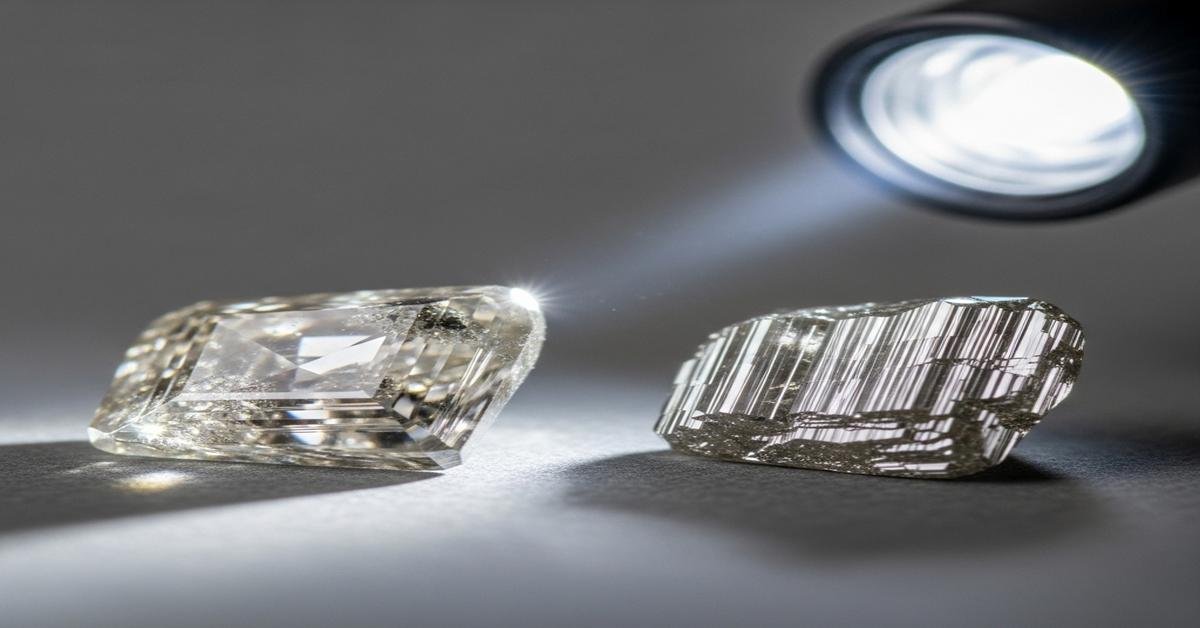
Holding a diamond under a phone torch is something many buyers and collectors try. It’s quick and feels practical. But can that little LED really tell you whether a stone was grown by HPHT (high-pressure, high-temperature) or by CVD (chemical vapor deposition)? Short answer: sometimes you can see clues, but most of the time a phone torch alone won’t give a reliable identification. Below I explain why, what to look for, how to test with a phone, and when you must rely on a lab.
How HPHT and CVD diamonds grow — and why growth lines form
HPHT and CVD are fundamentally different processes. In HPHT, carbon crystallizes under extreme pressure (roughly 5–6 GPa) and high temperature (about 1,300–1,600 °C) in the presence of a metallic catalyst such as an iron-nickel alloy. Growth occurs outward from a seed and often produces sectoral features and metallic inclusions. In CVD, carbon atoms are deposited layer by layer from a methane/hydrogen plasma onto a seed plate. That creates stacked, plate-like growth layers and vertical or curved striations.
Because the crystal faces grow unevenly, both processes leave internal contrasts — what people call growth lines, striations or growth banding. Those contrasts are optical differences in refractive index, slight changes in impurity content, or tiny inclusions. The spacing of bands can be tens to hundreds of microns (roughly 0.01–0.2 mm), so some are visible to the naked eye under the right lighting, and some require magnification.
What a phone torch can realistically show
A phone LED gives a small, bright, mostly white light that is not polarized and has limited intensity. That means:
- It can reveal large, high-contrast features: metallic flux specks in HPHT-grown stones, obvious layered banding in some CVD stones, and surface-reaching internal fractures.
- It cannot resolve fine microscopic growth patterns: faint sector lines spaced under ~50 microns are beyond its resolving power without magnification.
- It won’t replace specialized lighting: dark-field illumination, polarized light, UV excitation and spectrometry used by gem labs reveal features a phone torch can’t.
How to examine a diamond with a phone torch — step-by-step
Follow these steps to get the best chance of seeing growth lines or inclusions with a phone.
- Clean the stone. Oils and dust hide faint lines. Use warm water and a mild detergent, then dry with a lint-free cloth.
- Use a dark background. Black paper or a dark cloth increases contrast and makes faint bands easier to see.
- Use your phone camera in macro mode if available. Tap to focus on the diamond; lock exposure or lower brightness to avoid washout.
- Angle the light for grazing illumination. Hold the torch so the light skims across the surface of the stone — this emphasizes surface-parallel bands and striations.
- Rotate the diamond slowly. Growth bands often appear only at certain orientations relative to the light.
- Try both table-up and pavilion-up views. Some growth features are visible through the table; others show better through the pavilion facets.
- Use a simple clip-on macro lens or a loupe. A 10× loupe plus the phone torch increases diagnostic power a lot.
Typical clues you might see (and what they suggest)
- Parallel, stacked horizontal bands or “layered” appearance: More characteristic of CVD. These look like faint plane-parallel striations across the pavilion or girdle. They are often regular because CVD deposits material in layers.
- Curved or chevron-like sector boundaries and metallic-looking specks: These point to HPHT growth. Metallic flux inclusions can look like tiny bright, reflective specks or strings. HPHT sector boundaries can be angular or chevron-shaped.
- Strong planar fractures or feathers leading to a bright line under grazing light: These are damage-related and not a growth signature. Do not confuse polish lines or surface-reaching chips with growth lines.
- Dark “graining” visible as faint buses of color or lines: Could be growth-related or be from plastic deformation (strain). Distinguishing these requires polarized light or a microscope.
Common pitfalls and false positives
There are several ways a phone torch can mislead:
- Polish marks and facet junctions can mimic growth lines under oblique light. Polish lines are strictly surface features; they move when you change focus.
- Internal graining from natural deformation can look like growth banding but is not process-specific.
- Coatings, residue, or abrasions can obscure or create apparent lines.
- Treatment and post-growth processing (HPHT post-growth annealing, CVD overgrowth) can mask or alter growth patterns.
When a phone torch is enough — and when it isn’t
A phone torch can give you a quick, low-cost first look. If you spot metallic flux inclusions or very regular laminar banding, those are useful clues that should prompt further testing. For example, seeing shiny metallic flecks in a diamond under several angles of light is a strong sign of HPHT flux.
But if you need a definitive answer — for resale, certification, or insurance — a lab report is necessary. Gemological labs use tools a phone cannot substitute: binocular microscopes with dark-field and polarized illumination, infrared absorption to check nitrogen content, photoluminescence and Raman spectroscopy to detect growth-related defects, and UV to check fluorescence or phosphorescence. These methods identify growth type with high confidence.
Quick practical checklist
- Clean the diamond and use a black background.
- Use grazing light from your phone torch and rotate the stone slowly.
- Use your camera’s macro mode or a 10× loupe for better detail.
- Look for stacked layers (CVD) or metallic specks/chevrons (HPHT).
- If clues are ambiguous or the stone is valuable, request a lab report.
In short: a phone torch can sometimes show telling clues, especially in larger stones or when features are obvious. But it can’t provide a reliable, stand-alone identification. Use it for initial screening, not as a final test — and send important or valuable stones to a qualified gemological lab for confirmation.