Blog
Why Some Moissanite Reads “Blue” in Offices—and How to Fix It

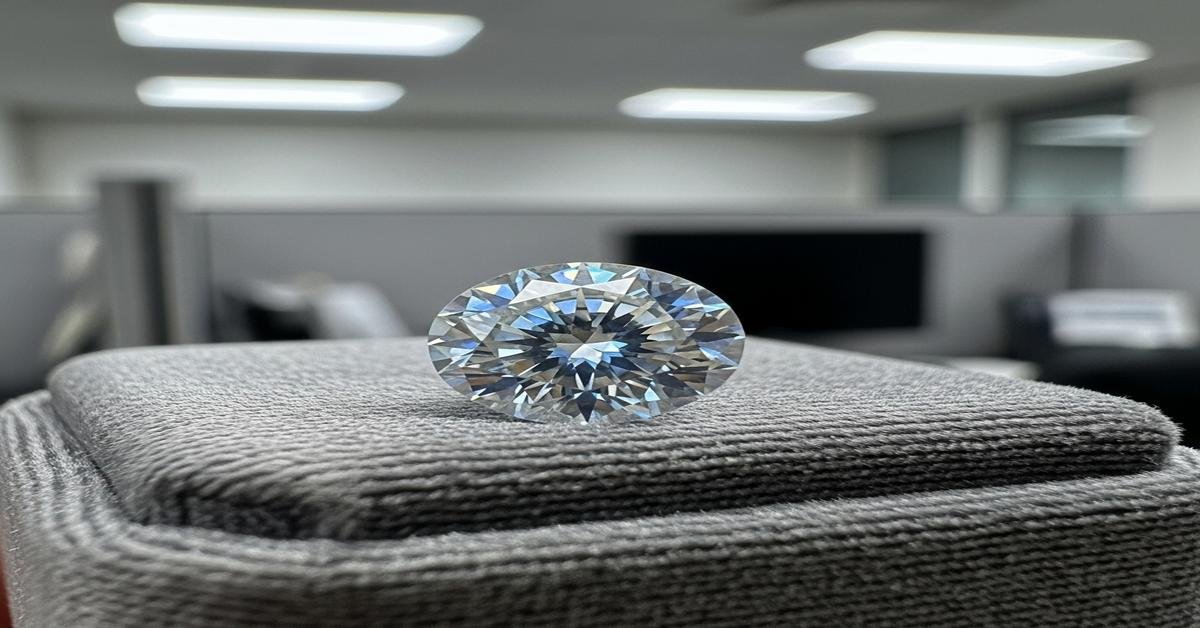
Moissanite often flashes bright colors under office lights. Many people describe that flash as a noticeable “blue” cast. That can be surprising when you want a neutral, diamond-like look. This article explains why moissanite reads blue in typical office conditions, how to tell if the stone or the environment is to blame, and practical fixes you (or your jeweler) can use to warm the look.
What “blue” means here
When people say a moissanite looks “blue,” they usually mean one of three things:
- Blue fire: blue spectral flashes from the stone’s dispersion.
- Cool overall tint: the stone appears slightly bluish-white, not warm or slightly yellow.
- Photographic/optical bias: cameras, lenses, or glasses make the stone read bluer than it appears to the naked eye.
All three are normal, but they come from different causes and need different fixes.
Why moissanite often looks blue under office lighting
There are four technical reasons:
- High dispersion (fire): Moissanite’s dispersion is about 0.104, roughly twice diamond’s (~0.044). Dispersion separates white light into spectral colors. In cool, fluorescent or high-CRI LED office lights, moissanite tends to flash blue and green more visibly because the light spectrum and the stone’s facets favor those wavelengths.
- Refractive index and birefringence: Moissanite’s refractive index ranges about 2.65–2.69. It’s doubly refractive (birefringence ~0.040), which splits light into two rays. That can produce strong, vivid color flashes—often with cooler tones—unlike the more neutral sparkle of a well-cut diamond.
- Lighting color temperature: Many offices use cool white fluorescent or 4000–5000K LED lights. Those lights have more blue energy than warm (2700–3000K) bulbs. Cool bulbs make any high-dispersion stone flash bluer.
- Setting and surroundings: Metal color affects perceived stone color. White metals (white gold, platinum) and bright, reflective desks or monitors bounce cool light into the gem. Yellow or rose gold adds warm reflections that neutralize blue tints. Clothing, skin tone, and nearby objects also change what you see.
How to tell if the stone or the environment is the cause
Do these quick tests:
- Hold the stone under a warm household bulb (2700–3000K). Does the blue vanish? If yes, lighting was the cause.
- Place the stone on a white index card under the same office light. If it still looks blue against pure white, the stone’s cut/dispersion is creating strong cool fire.
- Switch settings: move the ring from white gold to a yellow gold band or put a warm fabric under it. If the stone looks warmer, the setting is influencing color.
- Photograph with different white-balance settings. If the camera exaggerates blue, adjust white balance rather than the stone.
Practical fixes you can use right away
Some fixes are simple and reversible. Others require a jeweler or a new stone choice.
- Change the lighting: Use warmer bulbs at your desk (2700–3000K). A small warm-tone lamp makes a big difference because moissanite’s fire responds to the light spectrum.
- Wear warmer metal settings: Move the stone to 14k or 18k yellow gold or rose gold. The alloy composition matters: 14k gold is ~58.3% gold mixed with copper/silver; 18k is 75% gold with less alloy. Copper content in rose gold adds warm reflection and reduces the perceived blue cast.
- Use a warm-toned bezel or halo: Add small yellow gold or rose gold accents around the center stone. They reflect warm tones into the gem without changing the center stone.
- Adjust photography and eyewear: Set camera white balance to “incandescent” or manually toward 3000K. If you wear glasses with blue-blocking coatings, try removing them when judging color—coatings can shift perceived color.
- Change the background: Skin contact or warm fabrics beneath the stone counteract blue reflections. For rings, natural skin tone often reduces the effect compared with a white desk surface.
- Professional re-cut or different cut choice: If the stone’s cut creates excessive blue fire, a jeweler can recommend a cut with crown and pavilion angles that trade some fire for more white brilliance. For new purchases, ask for cuts designed to minimize extreme dispersion—some commercial moissanite cuts mimic diamond light return and show less colored fire.
When you may need a new stone
If you’ve tried lighting and setting changes and the stone still reads too blue, consider these options:
- Choose a different color grade or brand: Manufacturers market colorless grades (often labeled D–F) versus near-colorless (G–I). For moissanite, brands like Charles & Colvard offer “Forever One” (near-colorless/colorless ranges). Colorless stones can still show fire, but they often look more neutral overall.
- Pick a different cut: A 1.00 ct round moissanite is about 6.4–6.5 mm. Larger table or shallower crown angles increase white brilliance and reduce concentrated colored flashes. Discuss pavilion and crown angles with the seller; cuts designed to mimic classic round brilliant diamond proportions usually produce less overt “blue” fire.
- Try a different gem: If you want a truly diamond-like neutral look with minimal colored fire, a natural or lab-grown diamond has lower dispersion. That’s a material choice, not a workmanship problem.
Maintenance and practical tips
Keep the stone clean. Oils and film from hands or lotions can change how light enters and exits the gem. Use warm water, mild dish soap, and a soft brush. For settings with rhodium-plated white gold, remember rhodium plating can wear; fresh plating looks very bright and reflective, which can increase cool reflections. If you prefer less cool reflection, discuss alternative finishes with your jeweler.
Final practical advice
If you already own the ring, start with the simplest fixes: try warmer desk lighting and test a yellow- or rose-gold accent. Those often produce an immediate, pleasing change because they address the light spectrum and reflected color. If you’re buying, ask the retailer for specific cut details, the stone’s size in mm, and brand/color grade. That lets you choose a moissanite that balances sparkle with a neutral look for typical office lighting.