Blog
Solitaires Are Back—But With This 2025 Twist UK Brides Love


Solitaires are back on British fingers, but not as you remember them. The 2025 twist is a sleeker, lower, sculpted take—think rubover and collet-head solitaires, often two‑tone, hugging the finger and playing nicely with wedding bands. It is still a single stone centre stage, just engineered for modern life: the commute, knitwear, prams, laptops, and frequent hand‑washing. Here is what that looks like in practice, and how to spec one well.
What’s the 2025 twist?
The classic “Tiffany‑style” 4–6 prong is giving way to the rubover/collet solitaire—a smooth metal rim (full or partial) that wraps the stone. In the UK you will hear “rubover”; historically, “collet” describes a similar antique idea with a scalloped or enclosed rim.
Key differences from a tall prong solitaire:
- Lower profile: typically 5.0–6.0 mm off the finger versus 6.5–7.5 mm for many prong heads. Lower height snags less and wears better with gloves and sleeves.
- Shaped metal. Bezels can be oval, cushion, or octagonal to echo the outline of the stone. They frame the face and make the centre look larger because your eye reads the metal edge as part of the footprint.
- Two‑tone heads. A platinum (Pt950) head on an 18k yellow shank keeps the diamond bright while giving the warmth UK brides love.
- Modern variations. Half‑bezels (left/right or top/bottom), compass prongs (N‑E‑S‑W), and soft cathedral shoulders add structure without fuss.
Why UK brides love it now
- Practicality. Smooth rims and low heads do not snag knitwear or hair. They survive the Tube, pushchairs, and gym grips.
- Security. A rubover protects edges and corners (vital for ovals, pears, radiants). You are less likely to chip a girdle than with exposed prongs.
- Vintage‑modern mix. Georgian‑inspired collets meet clean, contemporary lines—timeless without looking “bridal‑cookie‑cutter.”
- Stackability. Properly engineered bezels and cathedral shoulders allow a wedding band to sit flush or near‑flush.
Shapes that flatter the new solitaire
Elongated cuts are the quiet heroes. They cover more finger and look substantial at modest carat weights.
- Oval. A well‑cut 1.5 ct oval often faces up ~9.5–10.5 × 7.0–7.5 mm. A thin bezel adds ~0.4–0.8 mm all around, so it reads closer to 11 mm long on the hand.
- Elongated radiant. Fire and crisp corners; 1.6 ct often measures ~8.5–9.2 × 6.5–7.0 mm. Bezel walls protect the corners.
- Elongated cushion. Softer outline, great in a milgrained collet. A 1.3 ct may be ~7.5–8.0 × 6.5–7.0 mm.
- Rounds and antique cuts. A 1.0 ct round is ~6.4–6.6 mm; in a rubover with a whisper of milgrain, it turns quietly “heirloom.” Old European and old mine cuts pair beautifully with collet heads.
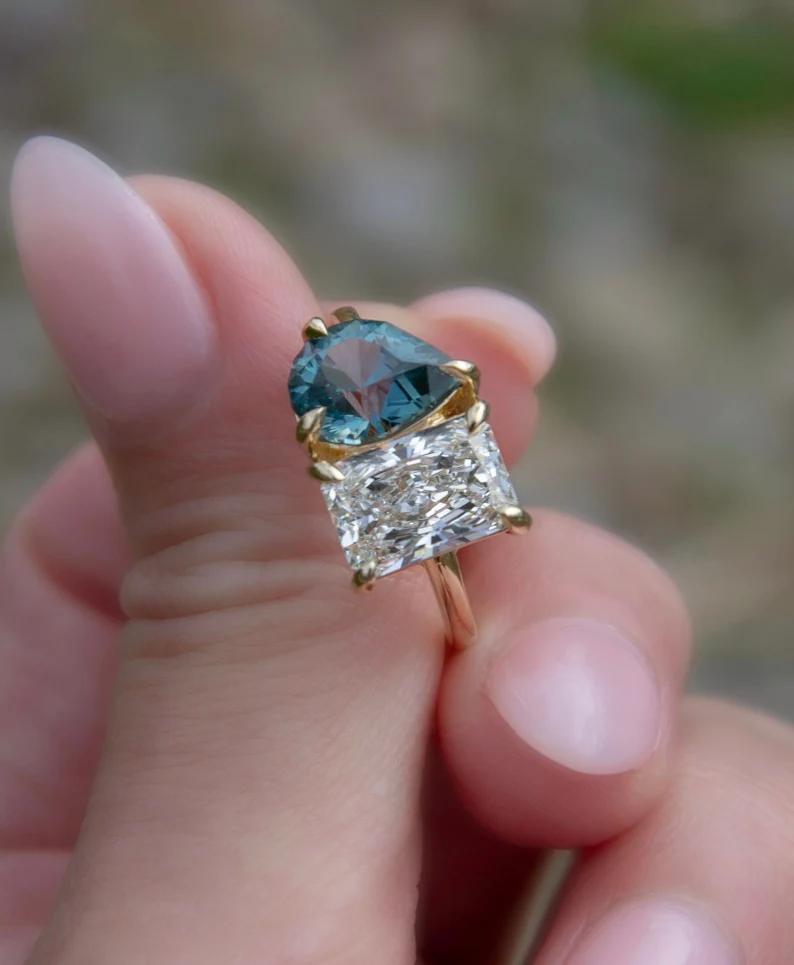
- East‑West accents. Marquise or oval set horizontally in a half‑bezel reads chic and modern on a slim shank.
The metal matters: UK‑smart alloys and two‑tone
- 18k yellow gold (750). ~75% gold, ~25% copper/silver. Warm, classic, and forgiving on daily scuffs. Many choose an 18k yellow shank with a platinum head to avoid yellow reflections into the diamond.
- Platinum (Pt950). Commonly Pt950/Ir or Pt950/Ru. Dense and tough; prongs bend rather than snap. Ideal for bezels and claws, especially on colourless stones.
- 18k white gold. Nickel or palladium alloy; typically rhodium‑plated for brightness. Expect re‑plating every 12–24 months if you like a crisp white look. For prongs, platinum is longer‑lasting.
- Two‑tone head. Platinum head on yellow shank is the 2025 default: white around the stone for brilliance, warmth on the hand for character.
Ask for UK hallmarking (e.g., 750 or 950 stamp with an Assay Office mark). It is your assurance of metal fineness.
Measurements that make it look refined
- Band width: 1.8–2.2 mm for most UK sizes (J–O). Below 1.7 mm can feel flimsy; above 2.3 mm looks chunky unless you want that look.
- Band thickness (depth): 1.6–2.0 mm. A true 2.0 mm feels solid and resists bending.
- Tapering: Taper the shank to ~1.5–1.7 mm at the shoulders to let the stone breathe.
- Bezel wall: ~0.6–0.8 mm thick with a crisp, even rim. Too thin risks deforming; too thick swallows the stone.
- Profile height: Target 5.0–6.0 mm off the finger for daily comfort; raise to ~6.5 mm if you need a wedding band to sit perfectly flush.
- Under‑gallery clearance: A soft scallop or gallery bridge prevents soap build‑up and allows easy cleaning.
Diamond (or lab diamond) specs that work
- Cut first. For rounds, insist on excellent cut and symmetry; a well‑cut 1.2 ct will outshine a poorly cut 1.5 ct. For ovals/radiants, look for lively facet pattern and minimal bow‑tie.
- Colour by metal. In 18k yellow or rose, G–I faces white; in platinum/white heads, stick to D–H if you prefer icy.
- Clarity for value. VS2–SI1 is the sweet spot if eye‑clean; mind feathers on corners in fancy shapes. Bezels help hide minor edge naturals.
- Lab‑grown vs natural. Lab diamonds offer larger looks per pound and are mainstream in the UK now. Expect a significant discount versus mined at the same specs; invest the saving in cut quality and a better setting.
Durability, resizing, and maintenance
- Bezels protect. Daily wearers benefit from edge coverage. Especially good for pears, marquise, and radiants.
- Resizing. Full bezels can be resized, but large jumps may require removing the stone to avoid heat damage. Plan within ±1 UK size if possible.
- Cleaning. Open under‑galleries clean easily with warm water, mild soap, and a soft brush. Closed antique‑style collets need periodic professional steaming.
- Plating. White gold needs rhodium refresh every 1–2 years. Platinum develops a soft patina; polish as desired.
- Service. Annual check of bezel lip or prongs; tighten if needed. Insure the ring and keep paperwork.
Budgeting: where the money goes
- Setting complexity. A crisp bezel or collet is labour‑intensive and uses more metal; expect roughly 10–20% higher setting cost than a simple 4‑prong.
- Metal choice. Platinum costs more than 18k gold due to density and labour. Two‑tone adds a small premium.
- Stone size vs face‑up. Elongated shapes look bigger per carat. A 1.2–1.5 ct oval can cover as much finger as a 1.7 ct round for less spend.
- Lab‑grown value. Often 60–80% less than mined at like‑for‑like specs, freeing budget for better cut and craftsmanship.
Tried‑and‑true UK combos in 2025
- The two‑tone oval bezel. 1.40 ct lab‑grown oval, G VS2, ~10.0 × 7.2 mm. Platinum full rubover head, 18k yellow shank 2.0 mm tapering to 1.6 mm at shoulders. Height ~5.6 mm. Sits near‑flush with a 1.8 mm wedding band.
- Antique‑mood round collet. 1.10 ct old European cut, H SI1 eye‑clean, ~6.6 mm. 18k rose collet with fine milgrain, softly scooped under‑gallery, cathedral shoulders. Band 2.0 × 1.8 mm. Warm, romantic, snag‑safe.
- Elongated radiant half‑bezel. 1.70 ct elongated radiant, H VS2, ~9.0 × 6.8 mm. Platinum half‑bezel east/west grips with talon corners protected; 18k yellow knife‑edge shank 2.1 mm. Height ~6.0 mm for wedding band clearance.
- Compass‑prong modern round. 1.00 ct round brilliant, F VS2, ~6.5 mm. Platinum compass prongs on 18k yellow tapered shank; low basket to 5.8 mm. Reads sleek and contemporary while still “solitaire.”
How to brief your jeweller
- “Rubover bezel, ~0.7 mm rim, open back, platinum head; 18k yellow shank 2.0 mm taper to 1.6 mm; overall height 5.8 mm.”
- “Set to allow a 1.8–2.0 mm band to sit flush; add a soft scallop under‑gallery for cleaning.”
- “Stone to face N‑S; minimal bow‑tie; no feathers at corners; eye‑clean at 15–20 cm.”
- “Finish: high polish on bezel lip, satin on shank if desired for scratch camouflage.”
Final checks before you say yes
- Look at measurements, not carats. Confirm mm dimensions of stone and bezel footprint on a ring sizer stick.
- Check height on finger. Close your fist, try with a straight 2.0 mm band to test fit.
- Inspect the rim. Even, tight bezel with no visible gaps; stone centred from all angles.
- Verify alloys and hallmarks. Ask for 750/950 and Assay Office mark on the finished ring.
- Confirm service plan. Cleaning and check‑ups yearly; rhodium schedule if in white gold.
The solitaire never left—but in 2025 it is sharper, lower, and more wearable. A thoughtful rubover or collet head, sized and alloyed for your lifestyle, gives you the elegance you want with the everyday ease UK brides keep asking for.