Blog
Inside a Micro-Pavé Workshop: Why Stones Keep Falling Out

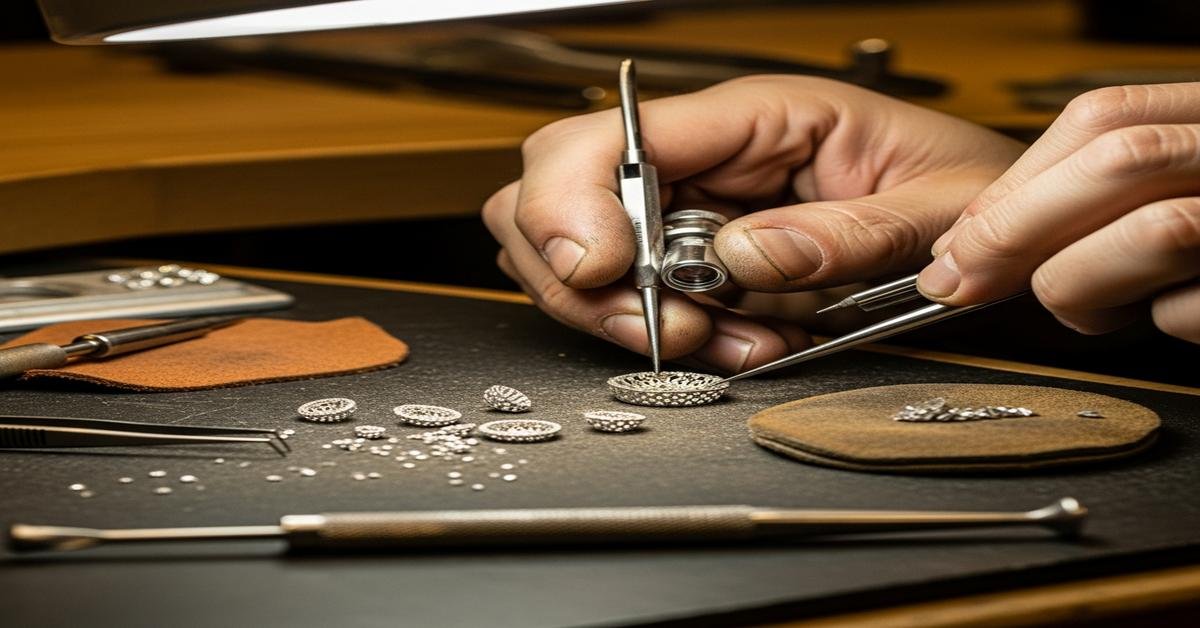
Micro-pavé looks delicate and seamless up close. Tiny diamonds, often 0.01–0.06 ct (about 1.2–2.6 mm), sit shoulder-to-shoulder on a metal surface. The visual result is stunning, but the technique is one of the most demanding in jewelry making. Stones fall out not because the jeweler is careless, but because small changes in metal, tool, stone, or process have outsized effects. Below I explain the practical reasons stones come loose and what a workshop can do to stop it.
Stone size, tolerance, and why a few hundredths of a millimeter matter
Micro-pavé uses melee diamonds with very tight size expectations. A 1.5 mm round brilliant typically weighs ~0.015–0.02 ct. The difference between a 1.48 mm and a 1.52 mm stone is tiny on paper. In practice that 0.04 mm changes how the stone sits in its seat and how much metal is required to form a secure bead.
Stone suppliers sort by size into sieves, but the sieve gradations and variations in girdle thickness mean many stones labeled “1.5 mm” are 1.45–1.55 mm. If seats are cut for the nominal size, an undersize stone will rock or sit off-center and beads won’t gain full contact.
Seat cutting: depth, angle, and mis-shapes
A good seat matches the stone’s lower girdle and pavilion so the girdle rests evenly. For round brilliants used in pavé, the seat is not flat: it’s a slight scoop cut with a small rounded bur. Typical seat depths are approximately 60–70% of pavilion height so the girdle sits on the seat without bottoming out on the culet.
Common mistakes:
- Using too large a bur for a 1.3–1.6 mm stone. A 1.2–1.4 mm cup bur is usually correct. A 1.6–2.0 mm bur over-cuts the seat wall.
- Cutting seats too shallow so beads only contact crown facets. That makes the stone prone to tipping and loosening under shock.
- Overcut seats that create undercuts or thin walls. Thin walls don’t support forming sturdy beads.
Bead size, placement, and metal control
Beads are the small bits of metal pushed over the stone’s girdle. Their width and height must be proportional to stone size and the thickness of the metal rail or head. For example:
- For 1.3–1.6 mm stones, bead widths often range 0.20–0.40 mm and bead heights 0.10–0.25 mm.
- For 2.0–2.6 mm stones, bead widths may be 0.35–0.60 mm and heights 0.20–0.35 mm.
If the beads are too skinny they will wear down or deform during polishing and cleaning. If they are too wide, they can stress the stone. Beads must also be centered over the girdle. Misplaced beads only contact facets and fail to lock the stone.
Metal alloy and hardness
The alloy matters. Eighteen karat gold (75% Au) is softer than 14k (58.3% Au). Softer metal flows easier when burnishing, which helps with displacement setting, but it also abrades faster in daily wear. Platinum (commonly Pt950) is much tougher and resists wear, but requires different tools and higher pressure to displace metal without cracking.
Example: A micro-pavé ring in 18k white gold will show bead deformation faster than the same design in Pt950. The trade-off is that platinum’s higher forming pressure can chip weaker melee if the beads are pushed abruptly.
Heat, soldering, and work-hardening
Soldering softens metal. After major soldering steps, the area around a pavé should be re-worked and the beads re-formed, because the previous work-hardening that kept the beads firm has been annealed. Some workshops skip re-hardening or don’t rework the beads, leaving a softer seat that wears down faster.
Also, excessive annealing can change grain structure in cast parts, creating porosity around seats. Porosity undermines bead integrity; beads formed over porosity will fracture or detach.
Tooling, ergonomics, and setting technique
Micro-pavé is done under magnification (stereo microscope, 10×–25×). Proper lighting, microscope parallax correction, and steady hand support matter. Tool differences are important too:
- Gravers and small cup burs: use sizes matched to stone diameter (e.g., 0.9–1.2 mm for 1.3–1.6 mm stones).
- Burnishers vs. beading tools: low-angle burnishers give smoother metal flow; pointed gravers cut instead of displace if used wrong.
- Stakes and anvil hardness: too hard an anvil makes beads crack; too soft causes over-deformation.
Setting technique includes pushing metal toward the stone progressively and forming the bead in stages. Pushing too much all at once can fracture the girdle or create micro-cracks that lead to loss later.
Polishing, ultrasonic cleaning, and plating
Polishing and ultrasonic cleaning are standard, but they stress tiny beads. Ultrasonic baths can vibrate a marginally secure stone free. Steam cleaning can likewise dislodge stones if beads are thin.
Rhodium plating covers white gold pavé. Plating can hide a loose seat by filling gaps, but it won’t secure the stone. As plating wears, the underlying looseness is revealed and the stone falls out. Never rely on plating as the primary retention method.
Quality control and workshop practices
The highest-performing shops use multiple checks:
- Size check: measure a sample of melee by caliper and sort by true diameter, not just supplier label.
- Seat verification: use setting gauges or test stones to verify seat fit before final setting.
- Microscopic inspection: check bead contact at 10×–25× after setting and after polishing.
- Final tests: gentle torque and vibration tests, plus a visual check for any gaps under microscopes.
Pressured workflows and pay-per-piece environments often cut corners. Rushing means less time for staged bead forming, less reworking after solder, and fewer inspections. Those shops will have higher fallout rates.
Fixes and long-term solutions
When stones fall out, common fixes are re-cutting seats, re-setting with larger beads, or re-tipping beads with laser soldering. For repeated problems consider design changes:
- Increase stone size slightly so tolerances are easier to control.
- Add supporting walls or tiny shared bezels to protect the girdle from impact.
- Use platinum for heavy-wear items like eternity bands.
For existing pieces: avoid household ultrasonic cleaners. Have a jeweler inspect pavé pieces annually. Small bead re-profiling and re-burnishing under a microscope can prevent a stone loss from becoming multiple losses.
What customers should ask and expect
If you own micro-pavé, ask the maker how stones were selected and measured, what alloy was used, and whether the piece was inspected under a microscope after plating and polishing. Expect regular maintenance—every 6–12 months—for pieces worn daily. Reputable workshops will welcome maintenance and will explain the trade-offs of comfort, sparkle, and long-term retention.
Micro-pavé is beautiful but fragile by design. Fixing falling stones is often a systems problem — wrong bur, wrong bead, wrong alloy, or rushed process. Address the root cause in the shop and the fallout rate drops dramatically.