Blog
Moissanite’s “Rainbow Fire”: Gorgeous Outdoors, Loud Indoors? A Week in London

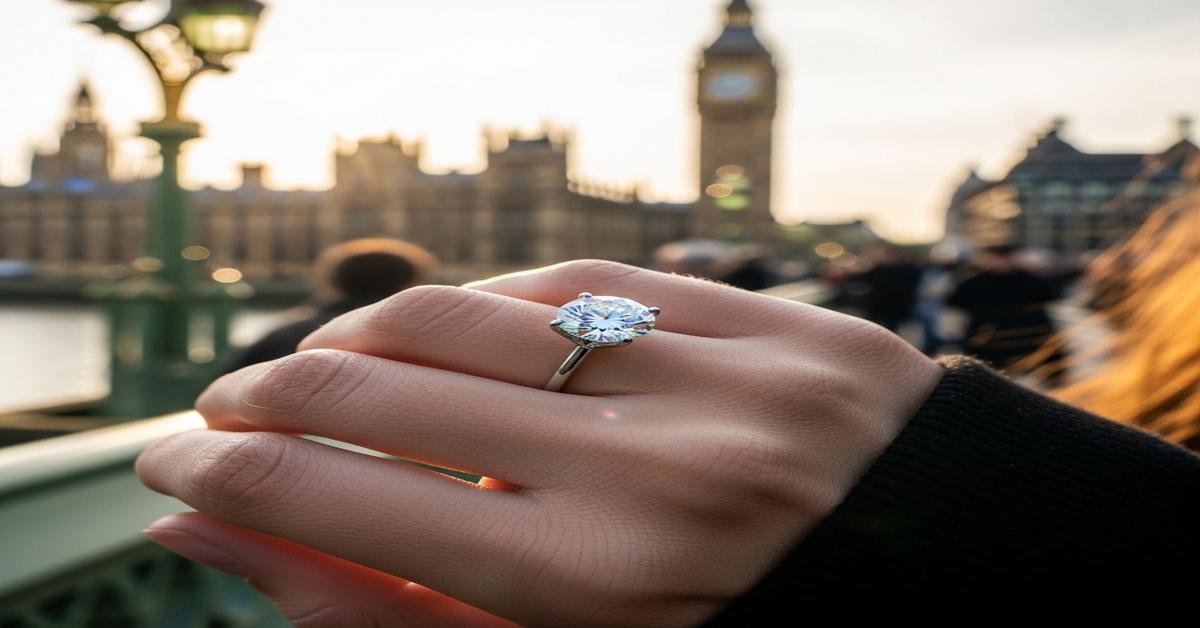
I spent a week in London wearing a 1.5 ct (about 7.4 mm) moissanite solitaire to test a common question: is moissanite’s famous “rainbow fire” more noticeable indoors than outdoors? The short answer is yes—but the full story matters. The way moissanite splits light, the types of light sources you encounter in a city, the stone’s size and cut, and even the metal of the setting all change how loud or subtle that fire looks. Below I describe the physics, what I actually saw around the city, and practical buying and styling tips so you get the look you want.
Why moissanite shows more rainbow than diamond
Moissanite has a higher refractive index (about 2.65–2.69) than diamond (2.42). It also has a much higher dispersion value—about 0.104 versus diamond’s 0.044. Dispersion is the technical term for how strongly a material splits white light into colors. Higher dispersion means wider, more vivid spectral flashes—what people call “fire.”
Why that can read as “loud”: moissanite doesn’t just disperse more light, it often returns that light in quick, colorful flashes (scintillation). When you see many small, bright point sources of light—LED spotlights, halogen bulbs, camera flashes—those flashes create vivid rainbows. Outdoors, light is often broader, diffuse, and lower in contrast, so the fire appears softer and more gem-like.
Specifics from a week in London
My week covered typical London conditions: bright-but-diffuse daylight on the Thames, heavy overcast in Bloomsbury, warm pub lighting, fluorescent lighting on the Tube, and bright LED spotlights in stores. Here’s what I observed on a 7.4 mm moissanite (roughly 1.5 ct look):
- Bright daylight (direct sun, obvious shadow): Distinct white sparkle and sudden color flashes where light hit the table facets. The fire was noticeable but controlled—clear, with single-color flashes rather than a rainbow across the whole stone. Why: full-spectrum sunlight plus high contrast from sharp beams.
- Overcast city light (diffuse): Softer overall brightness, more white brilliance than color. The stone looked “brighter” but less rainbow-y. Why: diffuse light brings less contrast and fewer point sources to create colorful dispersion.
- Underground/office fluorescents: Small, sharp flashes—sometimes bluish or greenish—depending on tube spectra. Fire was more apparent than in diffuse daylight. Why: fluorescent tubes have spikes in certain wavelengths that moissanite disperses into narrow colored flashes.
- Pubs and restaurants (warm tungsten/halogen or warm LEDs): I noticed strong, warm-colored fire—lots of orange and red highlights. In a candlelit pub the stone looked lively without feeling gaudy. Why: warm, continuous-spectrum sources emphasize warmer spectral bands and produce attractively warm fire.
- Jewelry store LED spotlights and club lighting: This is where the stone looked loud to some people. Small, intense spotlights produced vivid, rainbow flashes across the stone. Why: small, bright point sources + high dispersion = concentrated spectral flashes that read as “loud.”
Factors that make moissanite look loud or subtle
Not all moissanite behaves the same. Here are concrete variables and why they matter:
- Stone size: Below ~6.5 mm (about 1 ct for diamond-size comparison), fire is easier to control. Above ~7.5 mm, you get bigger facet faces and stronger overall dispersion. Why: larger facets return broader colored flashes.
- Cut and facet pattern: A well-proportioned brilliant cut with tight facet symmetry balances brilliance and fire. Some cuts emphasize fire (more pavilion angle variance); those read as louder. Why: facet angles determine how light separates and returns.
- Color grade/brand: Modern premium moissanite (e.g., Forever One) comes in “colorless” (D–F) and “near-colorless” (G–H) versions. Colorless stones can look crisper; near-colorless stones have a warmer body tone that can soften rainbow contrast. Why: body color affects perceived contrast of colored flashes.
- Setting metal: Platinum or 18k white gold (rhodium plated) reflects cool white light back into the stone and increases contrast, making fire pop. Yellow or rose gold warms the look and can mute the perceived rainbow. Why: metal color changes the background light the stone reflects.
- Lighting environment: Small, intense point lights (LED spots, stage lights) make moissanite look loud. Diffuse daylight, candles, or warm continuous light look gentler. Why: point lights create strong contrast and concentrated dispersive effects.
Practical buying and styling tips
Decide how you want the stone to behave, then choose accordingly.
- If you want subtlety: choose a smaller stone (≤6.5 mm), a colorless/near-colorless high-grade moissanite, a low-profile or bezel setting, and warm metal (14k/18k yellow or rose gold). These choices lower contrast and tame bright point-source fire.
- If you want sparkle and show: choose a slightly larger stone (>7 mm), an open prong setting, and wear where you’ll see spotlighting (evenings out). White metals and pavé settings increase perceived brightness and fire.
- Test before you buy: ask the jeweller to show the stone under LED spot, fluorescent tube, and natural overcast daylight. Bring your phone but don’t rely on photos—cameras often exaggerate color and sparkle.
- Avoid low-quality stones: inexpensive doublets or poorly cut pieces can have odd spectral behavior and dullness. Choose reputable brands and ask for cut grade or proportions if available.
Care and reality check
Moissanite is hard (about 9.25 on the Mohs scale), so it resists scratches well, but it can pick up oils that dull sparkle—clean with mild soap and a soft brush. Expect moissanite to look livelier than diamond in many artificial lights. That liveliness is a property, not a flaw. If you aren’t sure whether you want that personality, try wearing a sample for a few days in the environments you frequent: commute, office, evenings out.
In London I found moissanite to be elegant and adaptable. Outdoors, it read as bright and refined. Indoors—under spotlights and LEDs—its rainbow fire keeps conversations lively. Knowing how lighting, size, cut, and metal affect the gem lets you choose the balance you actually want.