Blog
Why Thermal Testers Fail on Moissanite—and What UK Jewellers Use

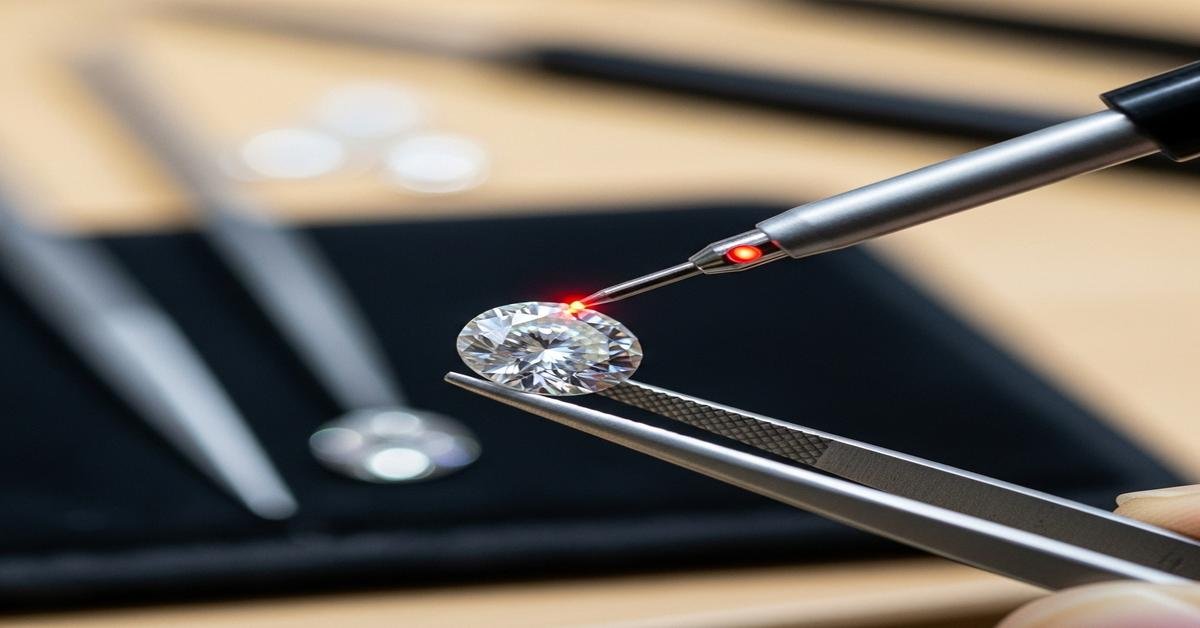
Thermal testers were once a jeweller’s fastest way to check a stone. They still work well for many gems, but they fail predictably with moissanite. Moissanite is not “like glass”; it is a hard, high‑refractive, highly thermally conductive crystal (silicon carbide). That combination is why a thermal probe often reads moissanite as diamond. This article explains the science behind the misread, shows what UK jewellers actually use in practice, and gives a simple, reliable testing workflow you can use in your store.
Why thermal testers give false positives on moissanite
Thermal testers work by applying a small, heated probe to a gemstone and measuring how fast heat is conducted away. Diamonds conduct heat much faster than most gems, so a fast response normally indicates diamond.
Moissanite also conducts heat very well because of its silicon carbide crystal structure. In short: both gem types move heat away quickly, so a thermal tester can’t reliably tell them apart. Add to that practical issues—small stones, tight settings, or a metal setting that acts as a heat sink—and the tester becomes even less reliable.
Key physical differences you can use:
- Refractive index (RI): Diamond RI ≈ 2.417. Moissanite RI ≈ 2.65–2.69.
- Birefringence: Diamond is essentially singly refractive. Moissanite is doubly refractive with birefringence ≈ 0.038, which produces visible doubling under magnification.
- Specific gravity: Diamond ~3.52; moissanite ~3.22. This difference matters only in laboratory-style SG tests, not casual bench work.
- Dispersion (fire): Moissanite’s dispersion is higher (≈0.104) so it flashes more spectral colours than diamond (≈0.044).
Why some newer testers do better
Manufacturers learned the limitation. Modern instruments often add an electrical conductivity check or use combined thermal+electrical sensing. Moissanite is a semiconductor and can show a measurable electrical response that natural diamond does not. A dual‑mode tester that checks both thermal and electrical conductivity will correctly separate most moissanite from diamond.
That said, no handheld device is 100% perfect. Probe contact, dirty tips, or stones with coatings or unusual settings can still give mixed results. Routine calibration and clean tips are essential.
What UK jewellers use in real practice
Experienced UK jewellers use a layered approach rather than relying on a single device. Here’s the standard workflow you’ll see in a well-run shop or workshop:
- Step 1 — Visual inspection (10× loupe): Look for doubled facet junctions at the pavilion or crown. Under magnification moissanite often shows double images—easy to see on facet edges and facet reflections. Also note unusually strong “fire” and sharp facet edges that don’t match known diamond cutting styles.
- Step 2 — Polariscope or polarization filter: A polariscope will show anisotropic behaviour for moissanite. Diamond is isotropic and usually shows no extinction pattern. This is cheap and quick and effective for many cases.
- Step 3 — Thermal tester (fast screen): Use a thermal tester as an initial check, but interpret a positive “diamond” read with caution. Treat it as an inconclusive result for any stone suspected of being moissanite.
- Step 4 — Electrical conductivity or dual‑mode tester: Use an electrical probe or a combined device. If the tester reports electrical conduction consistent with silicon carbide, you can confidently identify moissanite.
- Step 5 — Confirmatory tests (lab grade): For high value or ambiguous stones, send the piece for Raman spectroscopy or lab gem testing. Raman gives a definitive fingerprint for moissanite versus diamond. UK jewellers commonly use labs when a certificate or resale value depends on absolute certainty.
Bench tips that reduce mistakes
Small habits make a big difference:
- Remove stones from heavy settings when possible. A platinum or solid gold setting draws heat away and can create false readings on thermal probes.
- Keep probe tips clean and replace them regularly. Dirt, oil, or worn tips change contact and give wrong numbers.
- Train staff to spot doubled facets and excessive fire. Visual skills cut down the number of stones needing instrument tests.
- Use a polariscope routinely. It’s inexpensive and reliable for detecting birefringence in moissanite.
When to send a stone to a lab
For routine retail work you can reach a confident ID with loupe + polariscope + dual‑mode tester. Send stones to a gem lab when:
- They are high value or part of an insured item and a certificate is required.
- There is a legal or warranty reason to be 100% certain of identity.
- Tests give mixed or borderline results (coated stones, composites, mounted diamonds that could be lab-grown vs moissanite).
Practical equipment buying advice for UK jewellers
If you can make one purchase, buy a combined thermal+electrical tester or a compact electrical conductivity meter in addition to a good loupe and polariscope. A Raman unit is expensive and usually unnecessary in a retail shop—use a local lab for those cases. Also insist on training: a two‑hour focused session on spotting birefringence, facet doubling and how to interpret tester output returns value quickly.
In short: thermal testers alone are unreliable for moissanite. The solution is a layered approach—visual checks, polariscope, and an electrical or combined tester—backed by lab work when the value or paperwork demands absolute certainty. That workflow is what UK jewellers use every day to avoid misidentifying stones and to protect their customers and business.