Blog
Moissanite vs Lab Diamond in Overcast Light: Which Pops?

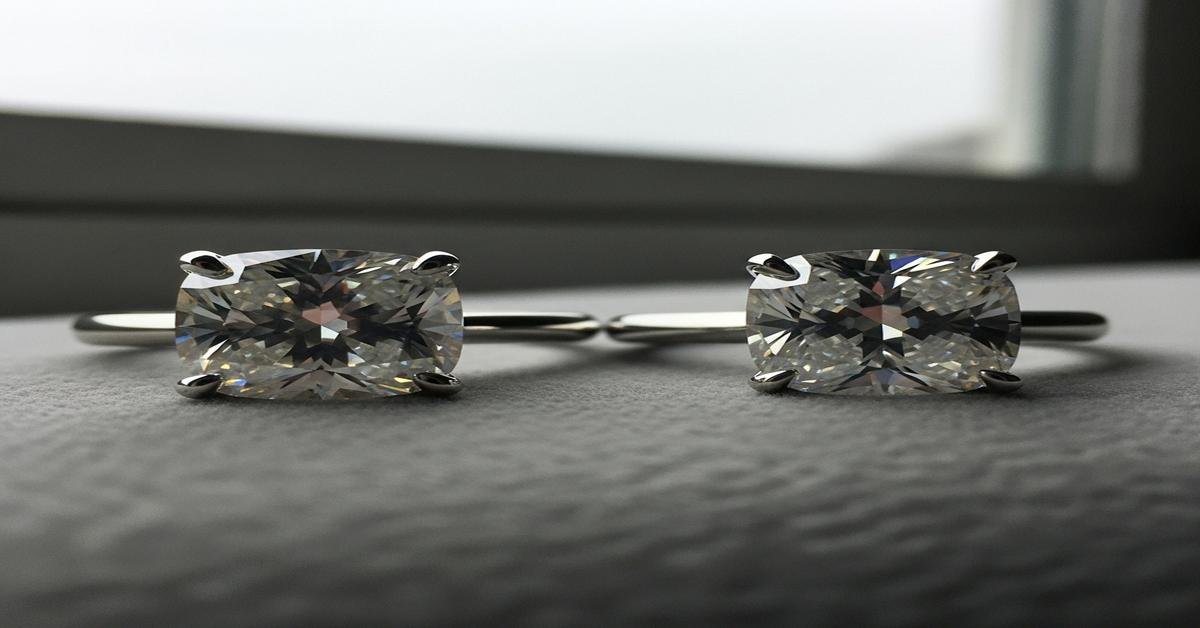
When clouds cover the sky, gemstones lose the dramatic spotlights of direct sun. Diffuse light puts a different test on stones: it reveals how a gem handles steady, even illumination. If you’re choosing between moissanite and a lab-grown diamond, this article looks specifically at how each “pops” in overcast light. I’ll explain the optical reasons, give numbers you can use when shopping, and list clear practical tips so you know what to expect on a cloudy day.
How light behaves differently in overcast conditions
Overcast daylight is mostly diffuse and cooler in color temperature (around 6000–7000K). That means fewer sharp reflections and more even illumination across the stone’s surface. Under these conditions, two optical traits matter most:
- Brilliance — the stone’s ability to return white light to the eye. This depends on refractive index and cut precision.
- Dispersion (fire) — the stone’s tendency to split white light into spectral colors. This shows as colored flashes.
Because the light is soft, you’ll generally see fewer pinpoint sparkles. Instead the stone’s sustained brightness and color flashes determine how much it “pops.”
Numbers that explain the look: RI, dispersion, density
Concrete values tell why moissanite and diamond look different.
- Refractive index (RI): diamond ≈ 2.417; moissanite ≈ 2.65–2.69. Higher RI means stronger bending of light and potentially brighter returns when well cut.
- Dispersion (fire): diamond ≈ 0.044; moissanite ≈ 0.104. Moissanite disperses light into colors about twice as strongly as diamond. That’s why it produces more rainbow flashes.
- Density: diamond ≈ 3.51 g/cm3; moissanite ≈ 3.22 g/cm3. For the same carat weight, moissanite will be slightly larger in diameter — roughly 2–3% bigger. A 1.00 ct round diamond is ~6.5 mm; a 1.00 ct moissanite of equal weight will be about 6.7 mm in diameter.
Why these numbers matter: in diffuse light, more dispersion means more visible color flashes even without direct beams. Higher RI helps return light evenly, which can appear as steady brilliance.
What you will actually see on a cloudy day
Short answer: moissanite often looks more lively and colorful; lab diamonds look more restrained and white. Here’s the practical breakdown.
- Moissanite: Expect strong, colorful flashes. In overcast light those colors are still visible because dispersion doesn’t need a direct light source to split wavelengths. The effect can read as extra “sparkle” or as rainbow flashes that draw the eye. If you prefer a vivid, attention-grabbing look, moissanite will usually deliver.
- Lab-grown diamond: Expect more white brilliance and subtle scintillation. Because diamond’s dispersion is lower, it produces fewer rainbow flashes and more white, contrast-driven sparkle. Under diffuse light a well-cut diamond looks elegant and luminous rather than flashy.
Neither is universally better. If “pop” means colorful flashes from every angle, moissanite wins. If “pop” means a clear, white sparkle that reads like a traditional diamond, the lab-grown diamond wins.
Cut, size and setting — the real modifiers
The material matters, but proportions and mounting matter more than people realize.
- Cut precision: Ideal proportions (crown and pavilion angles, symmetry, polish) maximize performance in any light. A poorly cut lab diamond can look dull in overcast conditions. Conversely, a well-cut moissanite that’s proportioned to control excessive fire will look balanced.
- Stone size: Larger table facets on big stones show broad flashes; smaller, well-placed facets create lively scintillation. For example, a 2.00 ct round (roughly 8.0–8.2 mm) can display broad color flashes in moissanite and deep white brilliance in a diamond, depending on cut.
- Setting and metal: Bright, reflective settings increase perceived brightness. White metals reflect neutral light: 14k white gold (58.5% Au alloyed with Ni or Pd, usually rhodium-plated) and 95% platinum both give a white backdrop. Yellow gold will add warmth and can make a near-colorless diamond look slightly warmer; it also changes how moissanite’s fire contrasts with the metal.
- Fluorescence: Some lab diamonds show blue fluorescence. In certain stones that can soften contrast in diffuse light and make the diamond look hazy. If you’re comparing diamonds in cloudy daylight, pick stones with faint or no fluorescence to avoid a washed appearance.
Durability and long-term appearance
Diamonds are the hardest known gem (Mohs 10). Lab diamonds share this property. Moissanite is very hard too (about Mohs 9.25). That means both stand up well to daily wear, but diamonds are slightly more resistant to abrasion and retain crisp facet edges longer. Over years of wear, a moissanite may show microscopic surface wear sooner than a diamond — not common, but something to note if longevity of a perfect finish is a priority.
Practical buying advice for cloudy-day performance
- Compare stones side-by-side outdoors on a cloudy day. Place them in identical settings and views. That’s the only true test for overcast performance.
- For a classic, white look: choose an ideal-cut lab diamond, low fluorescence, and color grade in the near-colorless to colorless range (D–H depending on budget). Prioritize cut quality over carat for better pop in diffuse light.
- For maximum visible sparkle and colorful fire: choose a high-quality moissanite with a well-controlled facet design. Expect more rainbow flashes in diffuse light.
- Think about setting: open or low-profile settings let more light into the stone. Halo and pavé settings increase apparent brightness by reflecting more metal and surrounding stones into the center gem.
- Consider size visually: since moissanite is slightly larger for the same weight, a 1 ct moissanite will look a bit bigger than a 1 ct diamond. If size is part of the “pop” you want, account for that.
In short: moissanite generally pops more in overcast light because of its higher dispersion and slightly higher RI. Lab-grown diamonds pop differently — more white brilliance and depth, less rainbow color. Decide whether you want bright, colorful flashes or a refined, diamond-like glow, then choose cut and setting to optimize that look on a cloudy day.