Blog
Car Interiors & Moissanite: Does Tinted Glass Overdo the Disco?

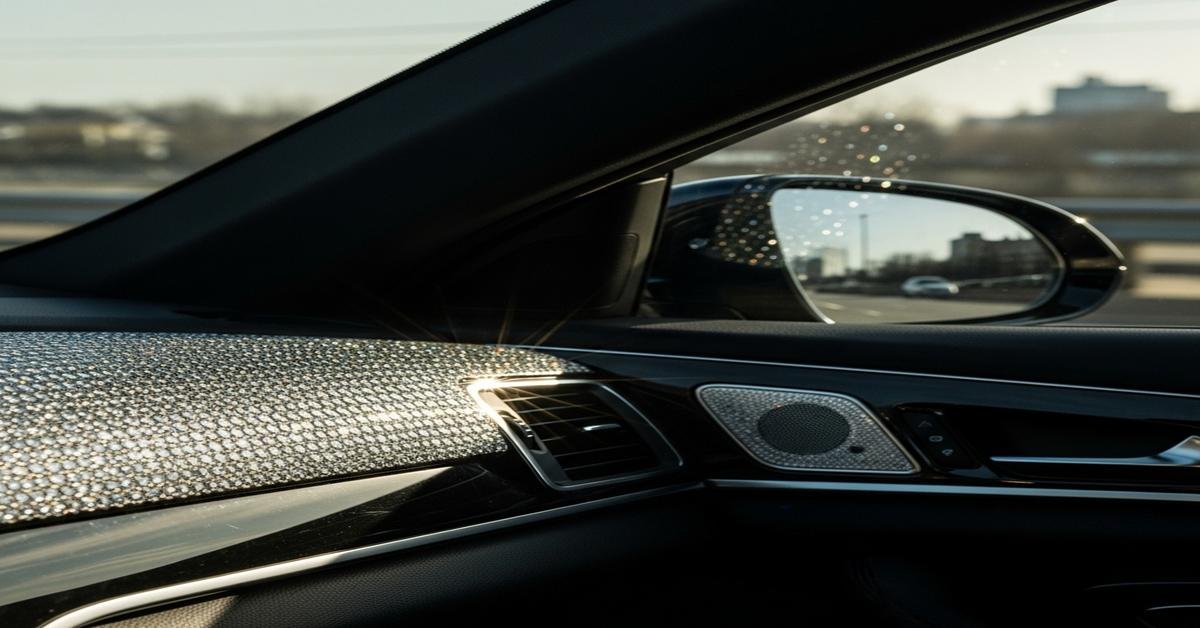
Moissanite is famous for its fire and brilliance. It scatters light more than diamond, so it can look very lively. Car interiors change the light that reaches a stone. Tinted glass, polarized windshields, and dark upholstery all alter how moissanite appears inside a vehicle. This article explains why, with numbers and practical tips so you can judge whether tinted glass calms or overdoes the “disco” effect.
How moissanite behaves in different light
Optical basics: moissanite has a refractive index of about 2.65–2.69 and a dispersion of roughly 0.104. For comparison, diamond’s refractive index is 2.42 and dispersion 0.044. Higher dispersion means moissanite flashes more color (fire). That’s why you see more blue, yellow, and green flashes in moissanite than in diamond.
Cut matters: brilliant cuts (round, princess) emphasize brilliance and fire. Step cuts (emerald, Asscher) emphasize clarity and have less fire. So the same tinted glass that tames sparkle on a round stone can make an emerald cut look flat.
What tinted car glass does to light
Tinted windows change three things that affect a stone:
- Brightness: measured as visible light transmission (VLT%). Common VLT values: 70% (light tint), 35–50% (moderate), 5–20% (dark). Lower VLT means less total light and less visible sparkle.
- Color balance: many films cut blue light and UV. That shifts overall light warmer. Blue-violet flashes from moissanite become less visible if blue is filtered out.
- Polarization and reflection: metallic or polarizing films reduce glare and compress reflections. They can either reduce distracting white glare or dull the small, bright flashes that make moissanite sparkle.
When tinted glass tames the disco — and why that can be useful
If your moissanite looks too “fiery” in bright sun, a moderate tint (VLT about 35–50%) can reduce the intensity of colored flashes. It lowers contrast between bright flashes and the stone’s background. That helps in two real situations:
- Everyday wear: inside cars during daytime, moissanite can throw bright blue or rainbow sparks that some people find flashy. Moderate tinting makes the stone look more balanced and less attention-grabbing.
- Photography in mixed light: if the interior light is harsh with direct sun, tinting softens highlights and prevents small, hot specular spots that overwhelm a camera sensor.
When tinting overdoes it — what gets lost
Very dark tints (VLT 5–20%) or films that strongly cut blue light can make moissanite appear dull. You lose three key elements:
- Fire: blue-violet flashes are muted since blue wavelengths are reduced.
- Brilliance: less overall light reduces internal reflections and return brightness.
- Color accuracy: near-colorless moissanite (G-H range) can look warmer or faintly yellow when blue light is removed. That’s a problem if you want a neutral look.
Example: a 1.0 ct round moissanite (~6.5 mm) in a car with 10% VLT will show much less sparkle than in open daylight. An emerald-cut stone, which already has low fire, can look nearly lifeless under the same conditions.
Glass type and coatings: not all tints are equal
Understanding film composition matters:
- Dyed films absorb wavelengths and often reduce blue light. They warm the scene.
- Metalized films reflect infrared and sometimes blue light. They reduce glare and can mute sparkle.
- Ceramic films block heat and UV with minimal color shift. They keep more natural color and preserve some sparkle compared with dyed films of the same VLT.
- Polarizing filters (rare as factory glass) can reduce polarized reflections that contribute to brilliance, changing how differently oriented facets sparkle.
Car interior color and background matter too
Stone appearance depends on background contrast. Dark leather or black dash makes bright flashes pop. Light beige seats bounce warm ambient light into the stone and can mute contrast. Metal settings (white gold, platinum) keep cool tones; yellow gold adds warmth. So a near-colorless moissanite set in yellow gold behind a beige headliner will read warmer than the same stone in platinum against a black dash.
Practical tips — how to test and control the effect
- Know your VLT: if possible, check the car glass VLT. Aim for 35–50% to reduce disco without killing sparkle.
- Try different angles: moissanite’s fire shows at different angles. Slightly tilt the stone toward the light or open a sunroof to restore sparkle without changing tint.
- Use ceramic tints: if you want UV/IR protection with minimal color shift, choose ceramic films.
- Avoid leaving jewelry on the dash: heat can damage settings and the glue in some mounts. Also, bright reflections can momentarily distract drivers or other road users.
- For photos: open a door or window for natural daylight. Use a neutral background (white tissue or gray cloth) to avoid color cast from upholstery.
Bottom line
Tinted glass can both tame and overdo moissanite’s disco. If your goal is a toned-down, everyday look, a moderate tint (35–50% VLT) or a ceramic film often works well. If you want maximum fire and color accuracy, avoid heavy tints or open a window/sunroof. Also consider cut, metal color, and interior background — they influence the result as much as the glass itself. With a few simple tests, you can choose the balance you prefer between sparkle and subtlety.