Blog
Can a Bench Jeweller Spot Moissanite in Seconds? Hatton Garden Tests

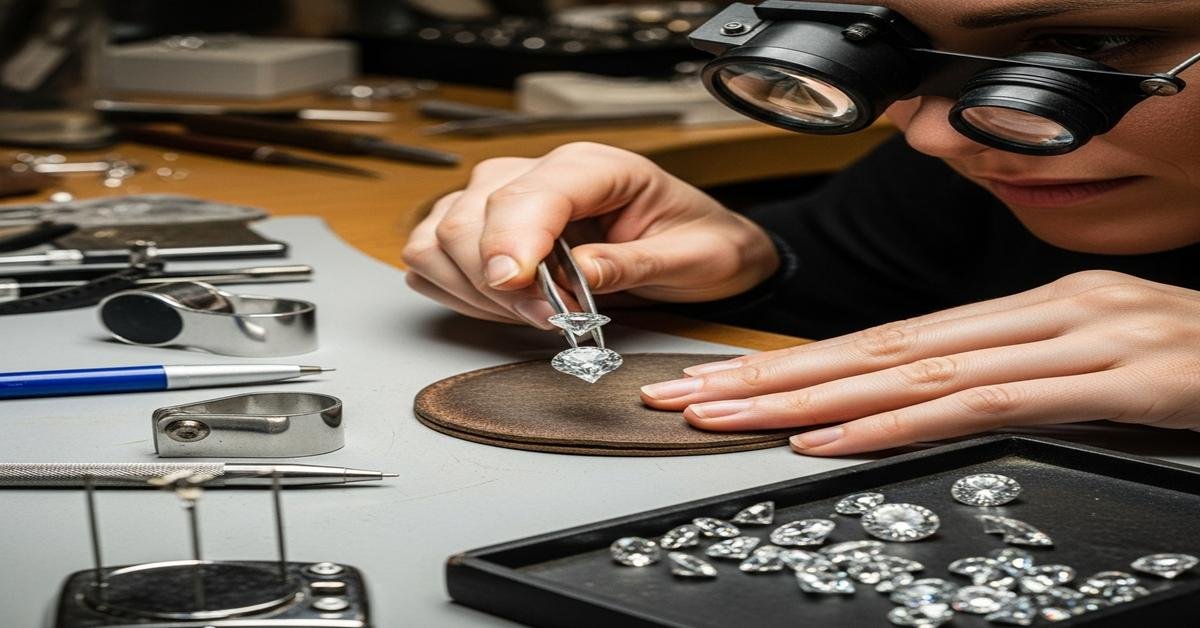
Bench jewellers in Hatton Garden get questions all the time: “Is that a diamond or moissanite?” Many people assume a trained eye can tell instantly. The short answer is: often, yes — but not always. Experienced bench jewellers use a mix of visual cues, simple instruments and pattern recognition. Those methods can identify most moissanite in seconds, but some stones and settings intentionally hide the clues. I’ll explain what jewellers look for, why those clues work, what the Hatton Garden bench tests found, and when a lab report is still necessary.
How moissanite differs from diamond — the measurable basics
Moissanite (silicon carbide, SiC) and diamond look similar at a glance. But they differ in a few key physical properties that affect how the stones behave under inspection:
- Refractive index and birefringence. Diamond is isotropic with an RI of about 2.417. Moissanite is anisotropic with a higher RI (roughly 2.65–2.97 depending on orientation) and strong birefringence (~0.04–0.30 depending on type). That means moissanite can show doubled facet lines or faint ghost images when viewed through a loupe or a polariscope. Diamond does not.
- Dispersion (fire). Moissanite has roughly twice the dispersion of diamond (about 0.104 vs 0.044). That produces stronger colored flashes — more “rainbow” fire — especially in well-cut stones and larger sizes (for example, a 1.00 ct round ~6.5 mm).
- Thermal and electrical conductivity. Diamond is an excellent thermal conductor. Moissanite also conducts heat well, so many older diamond thermal testers will misidentify moissanite as diamond. Moissanite’s electrical conductivity differs, which is why some modern “moissanite detectors” use electrical tests in addition to thermal tests.
- Hardness. Diamond is 10 on the Mohs scale; moissanite is around 9.25. That matters for wear and cutting, but a scratch test is destructive and not used by reputable jewellers.
Quick checks a bench jeweller can do in seconds
On the bench a jeweller wants a fast, non‑destructive result. These are the most common quick checks and why they work:
- 10× loupe — check for doubling. Look at facet junctions and the culet area. Moissanite’s double refraction can show a faint duplicated edge or “ghost” facet under 10×. Why it works: double refraction splits light into two rays; you see two images where diamond gives one.
- Polariscope or polarizing filter. Rotate the stone under polarized light. Moissanite will show anomalous extinction or persistent bright areas because it is birefringent. Diamond will go dark (isotropic). This is one of the fastest reliable checks if you have a polariscope available.
- Observe the fire and sparkle. Tilt the stone under a point light. Excessive rainbow flashes — especially pronounced on a 0.50–1.50 ct stone — suggest moissanite. Why it works: higher dispersion yields stronger colored flashes than diamond.
- Thermal tester with caution. A classic thermal diamond tester often reads moissanite as “diamond.” If the thermal tester says diamond, don’t stop there. Modern bench workflows use a moissanite-specific probe or an electrical conductivity tester as a follow-up.
- Microscope — examine inclusions and facet edges. Moissanite growth features differ from diamond. You might see needlelike or metallic flux remnants in lab-grown moissanite that don’t match diamond’s typical crystal inclusions. Also check the girdle and facet finish; poor polishing or certain facet shapes can be a clue.
What the Hatton Garden bench tests showed
A series of informal tests among several experienced Hatton Garden bench jewellers gives a practical picture. Jewelers were given mixed samples — loose stones and mounted pieces ranging from 0.10 ct melee up to 1.50 ct rounds and ovals — and asked to identify moissanite quickly. Results were consistent and instructive:
- With a loupe and polarized filter only, experienced jewellers correctly flagged moissanite in roughly 70–85% of stones within 10–30 seconds. The easiest were 0.50–1.50 ct stones where doubling and fire are obvious.
- Adding a polariscope or quick moissanite tester raised immediate accuracy to above 95% for stones larger than 0.20 ct. The polariscope is especially effective on loose stones; it becomes less reliable when the setting obscures pavilion facets.
- Small melee stones under 0.10 ct, pavé settings and closed bezels made rapid ID much harder. In those cases bench jewellers often removed the setting to test loose, or recommended lab verification.
Why these results matter: experienced hands and simple tools usually give a fast, correct answer for most everyday stones. But the exceptions are real — tiny stones, tricky settings, or stones intentionally altered (coatings, doublets) can fool quick tests.
When seconds aren’t enough — limitations and edge cases
There are clear situations where a quick bench check can be wrong or inconclusive:
- Small melee and pavé work. At 0.01–0.05 ct a stone is too small for reliable doubling or polariscope signals. Many pavé sets hide pavilion facets. A jeweller may need to remove and re-test under a microscope, or send a representative sample to a lab.
- Mounted stones with obstructed views. Bezel settings, heavy prongs or closed gallery settings block views of the pavilion, where doubling and inclusions are easiest to see.
- Treated or coated stones and composites. Moissanite doublets, coated stones or simulants combined with moissanite-like components can confuse simple tests.
- Fraud with lab-grown diamonds. High-quality CVD or HPHT lab diamonds share many optical properties with natural diamond and won’t show moissanite’s birefringence. Distinguishing those requires specialized instruments or a gem lab report.
Practical advice — what to do if you need a fast answer
- If you’re a buyer. Ask the seller for a current certificate for stones over 0.50 ct. Inspect under a loupe yourself if possible. Look for excessive rainbow fire in photos and beware prices that seem too good.
- If you’re a bench jeweller. Start with a 10× loupe and polariscope. If either shows signals consistent with moissanite, follow with a moissanite/electrical tester. Keep a microscope available for close inspection of inclusions and facet doubling. For high-value or ambiguous stones, send the stone or a small sample to a gem lab for RI and spectroscopy tests.
- Tools to carry. 10× loupe, polarizing filter or pocket polariscope, compact microscope or loupe microscope, a good thermal tester and a moissanite-specific electrical tester. Combined, these give quick, reliable answers in most cases.
Bottom line: a skilled Hatton Garden bench jeweller can spot most moissanite in seconds using a loupe and polariscope. But no single quick test is foolproof. The best practice is a short sequence of non‑destructive checks, and lab testing when the stone is small, heavily mounted, or high value.