Blog
Six-Prong vs Bezel: Which Tames Moissanite Sparkle Best?

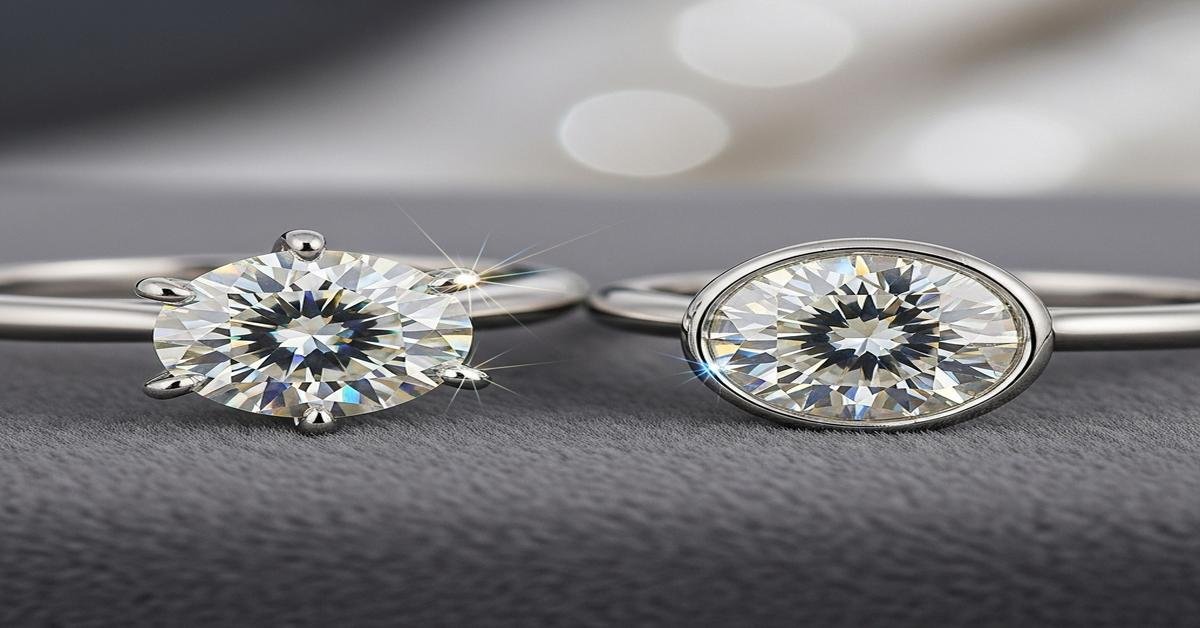
Moissanite is naturally more brilliant and more fiery than diamond. That extra sparkle is part of its appeal — and part of the challenge. Some buyers want to *show* that scintillation; others want to *tame* it so the stone reads as elegant rather than “too lively.” The two common ways to control how moissanite looks on the hand are a six‑prong setting and a bezel setting. Below I compare them practically: light performance, protection, daily wear, metal choice, shaping, and maintenance. I give clear examples so you can pick the setting that matches your lifestyle and taste.
How moissanite’s optics affect setting choice
Moissanite has a higher refractive index (about 2.65–2.69) and greater dispersion (~0.104) than diamond (RI ~2.42, dispersion 0.044). That explains why moissanite returns more white light and more colored flashes (fire). Settings change how much light reaches and leaves the stone:
- Open settings (prongs): let light in from the sides and bottom. That amplifies both brilliance and fire.
- Closed settings (bezel): block side light and constrain the angles where light exits. That tames fire and produces a more controlled, sometimes more “white” look.
Six‑prong: what it does and when to choose it
What it does: A six‑prong head holds a round moissanite securely while leaving most of the crown and pavilion exposed. Compared with four prongs, six prongs spread the holding pressure and reduce the chance the stone will twist if a prong bends. The open design → maximum light return and maximum fire.
Best for: people who want full brilliance and sparkle. Also ideal for classic engagement styles inspired by traditional diamond solitaires.
Practical notes:
- Security: Six prongs are more secure than four. They’re a good choice when the stone is 1.0 ct‑equivalent or larger (for a round, think ~6.2–6.8 mm for a 1 ct‑equivalent; 8.0 mm is roughly a 2 ct‑equivalent). For larger sizes you may want thicker prongs to avoid flexing.
- Snagging: Prongs project above the band, so they can catch on fabrics. That’s the trade‑off for brilliance.
- Metal and alloy: Use 14k gold or platinum for prongs. 14k gold (about 58.3% gold + 41.7% alloy) offers better wear resistance than 18k (75% gold), so prongs hold shape longer. Platinum (.950 fine) is excellent but costs more.
- Maintenance: Inspect prongs every 6–12 months. Retipping or reflowing prevents loss of the stone. Prong settings are easier to resize because the band isn’t integrated into a bezel.
- Cleaning: Pronged moissanite cleans easily. Ultrasonic cleaners are generally safe for the stone, but always consider the mounting and any accent stones.
Bezel: what it does and when to choose it
What it does: A bezel wraps metal around the girdle of the stone. A full bezel covers the stone’s edge completely. A partial or “half” bezel covers some of the edge while leaving parts open. Bezels reduce side light and visually mute fire. They give a low profile and a modern, secure look.
Best for: active lifestyles, everyday wear, people who prefer a sleeker look or want to visibly tone down moissanite’s flashes.
Practical notes:
- Protection: Bezels protect the girdle and vulnerable points (especially for pears, marquise, and emerald cuts). If you work with your hands, a bezel lowers the risk of knocks and chips.
- Appearance: Bezels can make the stone appear slightly smaller because metal covers part of the visible diameter. If you want the perceived size to remain large, choose a thinner bezel or a contrasting metal color (e.g., yellow gold around a bright stone can warm the look and make the center sit visually larger).
- Metal and alloy: Bezels use more metal. Platinum bezels are very durable but heavier and pricier. 14k gold balances durability and cost. If you choose white gold, expect periodic rhodium replating to keep the white look.
- Maintenance: Bezels are low maintenance on prong loss, but dirt can accumulate around the bezel edge. Cleaning requires careful attention to the seam between stone and metal. Resizing a bezel ring can be more complex because the metal profile is continuous.
- Design variations: Consider a scalloped or open gallery bezel. These let more light in from below while keeping the protective rim — a good compromise if you want less fire but not a fully ‘muted’ look.
Shape, size and metal choices that matter
Shape: Six prongs are most common for round stones. For fancy shapes, bezels or shape‑specific prongs are better: claws for ovals, V‑prongs or bezels for pears and marquise, full bezels for emeralds to protect corners.
Size examples: A round moissanite marketed as “1 ct‑equivalent” will typically sit near 6.2–6.8 mm in diameter depending on cut proportions; an “2 ct‑equivalent” round will be around 8.0 mm. The larger the stone, the more important the balance between metal coverage and visible surface area. Bezels can visually reduce perceived carat; prongs keep the perceived size maximal.
Metal specifics: – 14k gold (58.3% gold) is harder and better for prongs. – 18k gold (75% gold) is richer in color but softer; prongs wear faster. – Platinum (.950) is dense and durable for both prongs and bezels but adds cost.
How to decide — practical scenarios
- If you want to tame sparkle: Choose a full or partial bezel. A thin, open gallery bezel preserves more brightness while reducing fire. This is ideal for active wearers or those who prefer understated elegance.
- If you want maximum sparkle: Choose a six‑prong white‑metal setting with an open pavilion. Use 14k or platinum prongs and a higher gallery to let light flood the stone.
- If you want durability plus less flash: A domed bezel in 14k gold or platinum offers the best protection. Consider a half‑bezel to balance light and protection.
- If you’re unsure: Ask the jeweler for photos of the same stone in both settings or request a CAD rendering. Inspect how much of the girdle is covered and how light enters from the side.
Final takeaway
Six prongs maximize moissanite’s brilliance and show off its fire. Bezels control and soften that fire while providing superior protection and a sleeker profile. Choose six‑prong for classic, high‑sparkle looks and bezel for protection, low maintenance, or a toned‑down aesthetic. If you want a middle ground, try a partial bezel or a low‑profile cathedral with six slim prongs to keep light return but reduce loud flashes.