Blog
Alexandrite “Mood”: Lighting Tricks vs Real Colour Change

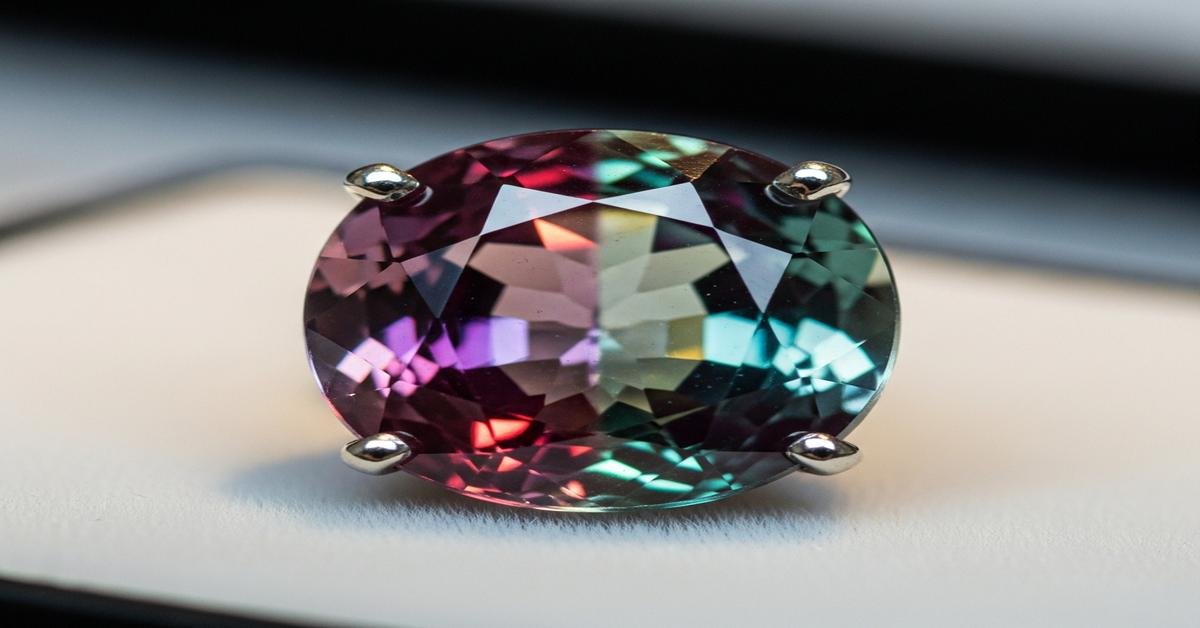
Alexandrite is famous for a dramatic trick: it can look green in daylight and red in incandescent light. That shift is real in natural chrysoberyl with chromium impurities. But many gems and treated stones can mimic that effect. This article explains how real color change works, why lighting and human perception matter, what tricks sellers use, and practical tests you can do before you buy.
What genuine alexandrite color change actually is
True alexandrite is a variety of chrysoberyl (BeAl2O4) in which small amounts of chromium (Cr3+) replace some of the aluminium. The chromium absorbs light in certain parts of the visible spectrum. Under a light source full of blue-green wavelengths (like daylight), the stone appears green. Under light rich in red wavelengths (like incandescent), the red transmission dominates and the stone appears red or purplish-red.
Why this matters: the change is not a simple tint shift. It is a change in dominant hue caused by the interaction between the stone’s absorption and the spectral power distribution of the light source. A strong alexandrite move is greenish-blue to a clear red. Stones that only shift from brownish to slightly purple do not have the same effect or value.
How lighting and perception affect what you see
Two factors control the perceived change: the light’s spectrum and your eye/brain. Common comparisons:
- Daylight — Natural north light or a daylight lamp (D65, roughly 6,500 K) has a balanced spectrum with lots of blue-green. This usually makes alexandrite look green to bluish-green.
- Incandescent — Traditional tungsten bulbs (about 2,700 K) emit more red and yellow. This tends to push alexandrite toward red or purplish-red.
- LED and fluorescent — LEDs and fluorescents vary a lot by design. Some mimic daylight closely and reduce the apparent change. Others are skewed and can exaggerate or mute the red. That’s why testing under true daylight and a warm incandescent source gives the clearest comparison.
Human factors matter too. Eye adaptation and surrounding colors change perception. Wearing a yellow gold setting will make the red side look stronger. Platinum or white gold shows colors more neutrally. For consistent comparison, view the stone out of its setting when possible.
Common tricks that mimic “mood” or color-change effects
Some sellers label items “mood alexandrite” or show dramatic before/after photos. Here are common fakery methods and why they fool the eye:
- Color-change glass — Glass can be made to change color under different lights. It’s cheap and often used for replicas. Glass has bubbles and a different refractive index than chrysoberyl.
- Doublets and triplets — Thin slices of color-change material glued to colorless crystal or capped with a clear dome. They can look convincing without being single gemstones.
- Dyed or coated stones — Surface coatings or dyes can give a temporary color change, especially when heated or viewed from certain angles.
- Thermochromic materials (mood rings) — These change with temperature, not light spectrum. Stones marketed as “mood alexandrite” sometimes use this tech rather than real alexandrite.
Why they differ: these methods change color for different physical reasons. Under magnification and instrument tests they behave unlike chrysoberyl. The change may appear abrupt or inconsistent when viewed under controlled light sources.
How to tell real alexandrite from tricks
Do simple, practical tests before you buy. Ask for these or perform them yourself if possible:
- Compare under two light sources. Use natural north daylight (or a D65 lamp) and a warm incandescent bulb (2700 K). A true alexandrite shows a clear, hue-based shift — green to red — not just a darker or lighter appearance.
- Inspect with a loupe. Natural alexandrite typically shows fine needle-like inclusions, “silk,” or fingerprint-type features. Glass shows round bubbles and curvilinear growth lines. Doublets often show glue lines.
- Check refractive index and specific gravity. Chrysoberyl has a refractive index around 1.74–1.76 and specific gravity about 3.73–3.78. Glass and many simulants differ noticeably. These are measurable with standard gem-testing tools.
- Use a spectroscope. Genuine alexandrite shows characteristic chromium absorption features. Many fakes lack that signature spectrum.
- Get a lab report for valuable stones. For stones over about 1.0 ct, ask for a reputable gem lab report that confirms species, origin, and whether the stone is natural or synthetic.
Practical buying tips and realistic expectations
Strong color-change alexandrite is rare. A one-carat stone with vivid green and clear red faces is already uncommon. Stones over 2 carats that show a strong, clean change are exceptional and command high prices. Lab-grown alexandrite exists and can show excellent change. That’s fine if disclosed, but price and value differ.
When buying:
- Ask for photos under both light types. Good sellers provide both daylight and incandescent images taken without heavy color correction.
- Prefer neutral settings (platinum or white gold) when you want to judge the stone by itself. Yellow gold will bias the red side.
- Request a return policy and, for expensive purchases, a lab report (GIA, AGL, or similar) that states natural vs synthetic and any treatments.
- If budget is limited, consider color-change sapphires or verified synthetic alexandrite as an honest alternative. They can give the look at lower cost, but know what you are buying.
In short, real alexandrite is a fascinating stone whose color change depends on physics. Lighting tricks and treatments can mimic that magic. Use simple light tests, magnification, and instruments when needed. Ask for proof and a return option. That’s the best way to get the real thing and avoid “mood” marketing that only pretends to be alexandrite.