Blog
Low-Profile Baskets: Can You Keep the “Big Look”?

Low-profile baskets are a practical choice for everyday rings. They lower the stone closer to the finger so the ring is comfortable, less likely to snag, and sits better under clothing. The question many people ask is: can you still get the “big look” — the visual impact of a larger, brighter center stone — when you choose a low-set basket? The short answer: yes, with deliberate choices in stone, cut, setting design and metal. Below I explain the trade-offs and the specific design moves that keep a ring bold without adding height.
What “low-profile” means in numbers
Designers measure profile from the top of the band to the table (top) of the gemstone. Typical heights:
- High-profile: roughly 3.5–6 mm (classic solitaires, cathedral heads).
- Medium-profile: roughly 2.5–3.5 mm.
- Low-profile: roughly 1.0–2.5 mm — the table sits almost flush with the top of the band.
When you target 1.5–2.0 mm, the ring is comfortable and snag-resistant. The engineering challenge is keeping light into the stone and creating the perception of size without adding height.
Choose the right stone and cut
Face-up size (mm) and carat weight are not the same. Different cuts produce different diameters for the same carat weight.
- Round brilliant — a well-cut 1.0 ct round is about 6.4 mm face-up. Rounds are brilliant but need good pavilion depth to return light; overly shallow rounds look larger but lose sparkle.
- Oval, marquise, pear — these shapes have longer face-up dimensions for the same carat weight. A 1.0 ct oval can look visually larger than a 1.0 ct round even if both sit low.
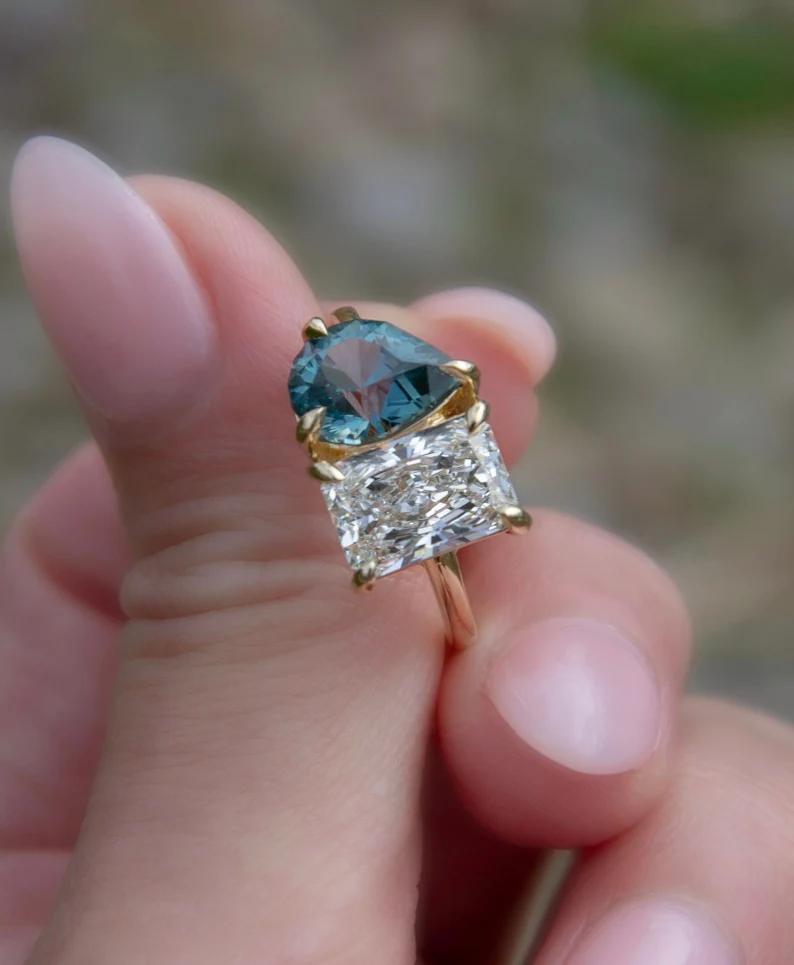
- Emerald and asscher — step cuts show more surface area (table) but less brilliance. They read larger from the top while staying elegant and low.
Practical rule: if you want a bigger face without extra height, consider an elongated shape (oval, marquise, emerald) or a slightly shallower pavilion within acceptable cut tolerances. But don’t go so shallow that the stone looks washed out. Ask for exact depth% and table%: for rounds, aim for a depth in the 58–63% range for good balance of size and brilliance.
Settings that create a big look while staying low
The setting does more visual work than most clients expect. These approaches boost perceived size without increasing height:
- Halo (single or double) — a thin halo of small melee diamonds around the center adds millimeters of apparent size. A 1 mm halo on each side increases the visual diameter by ~2 mm. Because halos are low and sit close to the center, they don’t add much height.
- Thin prongs and open basket — slim prongs (0.8–1.0 mm depending on metal) expose more of the stone’s edge. An open basket or “spider” head uses thin wires to hold the stone, reducing metal visually and making the stone look larger.
- Wide, low bezel (shadow bezel) — a shallow bezel with a high-polish inner lip reflects light into the girdle area, making the stone look larger. Keep bezel walls minimal (around 0.8–1.0 mm) and polished to avoid blocking light.
- Split shank and pavé shoulders — widening the band and adding pavé creates a broader top surface, giving a feeling of scale that complements the center stone.
- Open under-gallery and light channels — low-set heads with generous openings beneath the stone allow light to enter from below, preserving brilliance even when the table is close to the finger.
Metal and construction considerations
Metal choice affects how thinly you can make the elements that hold the stone — and therefore how much stone is visible.
- 14k gold (yellow/rose/white) — harder than 18k, so you can use slightly thinner prongs and walls (common prong thickness around 0.8–1.0 mm). Good balance of strength and thinness.
- 18k gold — softer; needs thicker walls for durability, which can hide more of the stone’s girdle if the head is very low.
- Platinum (Pt950) — strong but malleable; prongs often run 0.9–1.1 mm. It’s durable for daily wear, but platinum prongs usually look thicker than 14k gold prongs at the same size.
Ask your jeweler for specifications: prong thickness, bezel wall thickness, and whether the under-gallery is open. Small changes in those numbers change how much stone shows and how “big” it reads.
Trade-offs: durability, light, and comfort
Every design choice has a reason. Here are the real trade-offs and how to manage them.
- Durability vs exposure — thin prongs and open baskets expose more of the girdle and are more vulnerable to knocks. Balance slim prongs with stronger alloys or reinforced prong bases.
- Light return vs shallow cuts — choosing a shallower cut to gain face-up size can reduce brilliance. Compensate with a halo or pavé to maintain sparkle.
- Comfort vs accessibility — very low profiles are comfortable, but if the gallery is too closed you’ll lose light access. Keep an open cavity beneath the stone for light and cleaning.
Practical examples
- 1.0 ct round (≈6.4 mm) in a 1.8 mm low basket with a single 1 mm halo: appears closer to a 1.25–1.35 ct visual without added height.
- 1.2 ct oval (≈8.0 x 5.5 mm) in a thin-prong open head at 1.6 mm height: looks larger lengthwise and reads much bigger on the finger than a 1.2 ct round set at the same height.
- 1.5 ct emerald cut with a shallow bezel (0.9 mm wall) and open under-gallery: big table effect and a sleek, low silhouette that reads high-end and substantial.
Final checklist before you commit
Ask your jeweler these specific questions:
- What is the head height (mm) from band to table?
- How thick are the prongs or bezel walls (mm) and what metal is used?
- Is the under-gallery open for light and cleaning?
- What are the stone’s depth% and table% (for rounds) or table width% (for step cuts)?
- Can I see CAD renders or a physical mock-up at actual size?
With careful choices — shape, cut proportions, a halo or open basket, and the right alloy — you can absolutely keep the “big look” in a low-profile ring. Low-set designs require more planning but reward you with an elegant, durable ring that looks larger without sitting proud of the finger.